By JASON MATTHEWS
Workforce teams are dedicated and work diligently to serve their customers, yet outcomes are not always consistent. This is not a reflection of staff commitment or capability; it is the result of work that is unaligned to a shared outcome.
When the goal is not clearly defined:
- Staff do what they think is right, but expectations vary
- Case managers and business services define “ready” differently
- Programs celebrate placements that don’t last
When the system is organized correctly, the work becomes clear and consistent. Roles, expectations, handoffs, and outcomes all align because everyone is operating from the same structure. The solution is more straightforward than it may seem—if retention is the goal, the entire process must be intentionally built to support it.
In workforce programs, that process has a name: job readiness.
I. Process is Job Readiness
In many workforce offices, breakdowns in customer flow and missed benchmarks can be traced back to a single issue: there is no shared definition of “job ready.”
Disabled Veterans’ Outreach Program specialists and case managers often determine that clients are “ready” once basic employment barriers are addressed. At the same time, Local Veterans’ Employment Representatives and job developers expect candidates who can confidently represent both themselves and the program to employers.
Job Readiness Isn’t a Feeling
Job readiness isn’t subjective; it’s a defined sequence of steps.
Not “I think they’re ready,” but
“They’ve completed A, B, C, and D, and that’s what we require before employer engagement.”
Both perspectives are valid, but without alignment, they can lead to inconsistent outcomes.
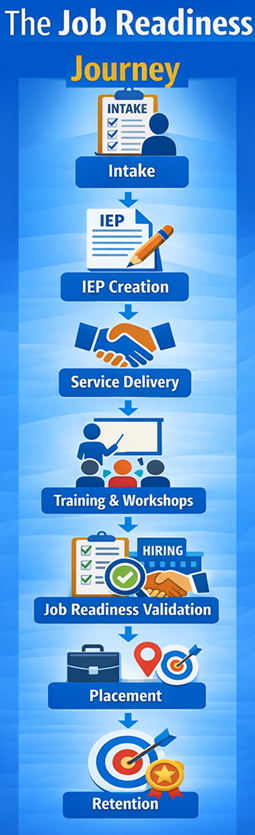
In workforce programs, effective process management begins with one critical step: clearly defining your job readiness process. [1] Strong case management exists, and strong business services exist—but without a shared process, there is no bridge connecting them.
That’s where a job readiness checklist comes in.
A job readiness checklist clearly defines:
- What must be completed
- What “ready” really means
- When a participant moves from case management to employer engagement
- What do business services expect before they take over?
What changes when everyone shares the checklist:
- Expectations are clear
- Handoffs are smoother
- Conversations shift from opinion to process
Most importantly, placement quality improves and retention follows, because everyone is now working from the same definition of “ready.” [2]
II. Break Job Readiness into Clear, Manageable Steps
Once your job readiness checklist is defined, the next step is to make it actionable by breaking it into concrete steps your team can follow every day.
Breaking job readiness into clear steps makes the work visible and consistent. Staff know what comes next, teams align around shared expectations, and handoffs become smoother with everyone on the same page. The system no longer relies on individual judgment. It relies on a shared process. That’s where consistency begins, and clients move forward with purpose instead of guesswork. [3,4]
The challenge isn’t missing steps—it’s that those steps aren’t consistently connected or as part of a shared process. [5]
A Disabled Veterans’ Outreach Program specialist or case manager may determine a client is ready for employment based on progress made in addressing barriers. The client is then referred to the Local Veterans’ Employment Representative or business services team for job placement support. However, if there is no clearly defined standard for what “job ready” means at that point in the process, the receiving team may not agree that the client is fully prepared.
When that happens, the referral doesn’t move forward, the client is left in limbo, and the process stalls. This creates friction between teams, confusion for the client, and inconsistent outcomes.
This isn’t simply a communication issue—it’s a process design issue. The transition between teams should not be an informal handoff; it should be a clearly defined step within the job readiness process, with shared expectations for what must be completed before moving forward. [4]
III. Define What “Good” Looks Like (Using Workforce Benchmarks)
Once you’ve broken job readiness into clear steps, the next question is simple: what does “good” look like at each step? If your team can define and agree on clear, intentionally answers at every stage, you’ve created a process that can be managed and metrics that can be measured.
The key is to ground metrics in what staff already do every day. When you define best practices and turn them into benchmarks, those benchmarks become a measurable process. [6]
For example, a team wants to improve job readiness outcomes but feels stuck on how to measure progress. Instead of introducing complex metrics, they simplify the approach. They define leading indicators as the everyday activities that move participants forward—like completing a resume or attending mock interviews—and lagging indicators as the results that show success towards retention.
Think about your staff like runners in a marathon. They’re working hard, but without clear distance markers they start guessing. That’s where anxiety, inconsistency, and burnout show up.
Metrics are the distance markers. They don’t create pressure—they create clarity.
By starting with the work they’re already doing, the team identifies their best practices, turns those into clear benchmarks, and uses them to track progress. What once felt abstract becomes a straightforward, measurable process, where best practices turned into benchmarks, and benchmarks into results. Imagine your data, or experiences, show that participants who attend interview workshops are more likely to be placed. That insight transforms the workshop from a helpful suggestion into a required step in your process. Completing the workshop becomes a clear marker of job readiness and a leading indicator of progress. Now your team isn’t just recommending workshops, they’re guiding participants through a defined step that directly moves them closer to employment.
Now let’s look at the back end of the process. If you know that monthly follow-up calls increase retention, those calls should no longer be optional – they should become a required part of how your program works. Each follow-up call is now a defined step in the process, while retention becomes the lagging indicator that shows the system is working. This is how activity connects to outcome, turning everyday work into measurable progress. [7]
IV. Leading the System: Calibration, Not Control
Once job readiness is clearly defined, broken into steps, and aligned around what “good” looks like, you can finally see how the system is working. And when the system is visible, your role as a leader changes.
Weekly meetings stop being simple check-ins and become calibration sessions. Instead of asking for general updates, ground the meeting’s focus on the work itself: where participants are in the process, who is progressing, where people are getting stuck, and which activities are leading to placement and retention. Clear, consistent steps help staff know exactly where they and their participants are in the process so they can manage their work effectively. Calibration keeps everyone aligned, preventing workarounds and inconsistencies. This isn’t micromanagement—it’s maintaining a clear, reliable system.
Once the system is in place, leadership becomes more focused and less reactive. Instead of chasing updates, you can spot patterns, fix bottlenecks, and reinforce what’s working. The next challenge is how your team operates within it.
V. What Comes Next
Our next article, Building Experts, will focus on ownership—who is responsible for each step of job readiness and how to develop staff who understand the full workforce system and partner network, not just individual cases. After that, we’ll explore what happens when the system works: how leadership shifts from oversight to trust, and how meetings change when staff no longer need constant direction.
Finally, we’ll tackle the last barrier: time. How can you protect your team’s ability to execute the process without constant interruptions?
Improving outcomes isn’t about making your team work harder, it’s about designing a system that makes success visible, repeatable, and aligned.
- Courses: 9610: Career Coaching for Special Populations Foundations, Prerequisite for 9610
- Podcast: Episode 12: DVOP/CVSO: Promising Practices to Connect and Serve all
- Courses: 9608: Disabled Veterans Outreach Program (DVOP) Specialist Core Competency Development* LVER
- Courses: 9609: Local Veterans’ Employment Representative (LVER) Core Competency Development* DVOP
- Courses: 9615: Logic Modeling to Strengthen Veterans’ Programs (HVRP Focused)
- Course: 9613: Business-Driven Workforce Solutions
- Podcasts: Episode 15 Addressing Burnout and Secondary Trauma for Veteran Service Providers